InTrivia

Metamorphosis: Titian 2012, at the National Gallery, London

Inspiration is a difficult word. Many artists seek it, whilst others deny its existence. The alternative to inspiration is investigation: a laborious approach that sometimes leads to a life’s work. Transcription can be the convenient middle ground between inspiration and investigation.

Titian was a painter during the Renaissance: a period when almost all works of art were transcriptions. Metamorphosis at the National Gallery uses Titian’s re-interpretation of Ovid as a starting point. New contributions from Mark Wallinger, Chris Ofili and Conrad Shawcross brush alongside those of seven choreographers and the Royal Ballet. The result is a complex gathering of fine art, design, musical arrangement and performance.

Diana and her entourage of nymphs are in sharp focus. The Royal Ballet’s nymphs are bruised, lithe and nimble, whilst Titian’s are voluptuous and reclined. Ofili’s Diana is Trinidadian and ephemeral, while Shawcross represents her as a robot with a magic wand. For Wallinger, Diana is real and on the toilet and we are peeping toms.

Titian’s paintings came from a deep and sustained interest in Ovid’s poetry, but the meaning given here is in pure assemblage rather than continuity. Contemporary transcription in the hands of an art historian as curator has resulted in neither conversion nor subversion, but diversion – and some handy commissions.


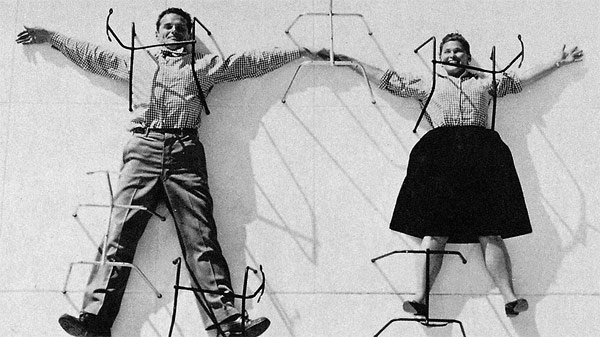
“Eames: The Architect and Painter” – Forget-me-nots provide the perfect ending

It takes a particularly strong conviction for two people to entrust both their intimate and public lives to each other. “Eames: The Architect and Painter” tells a neat story of Eames design, and of untidy workplace relationships; not only of the main protagonists but also those colleagues and clients that manoeuvred around them.

The Eames office is shown as an unorthodox circus of free-flowing collaboration (“understanding is the only thing that cannot be delegated”) though we learn how Charles was unwilling to share the design-credit with his staff. His hand is presented as simultaneously paternalistic and child-like. Time is wasted on naïve experiments on films made with toys and handmade models, and major corporations are happy to work with gentleman’s agreements. Meanwhile, Ray writes detailed instructions for absolutely everything on cigarette cards, devises colour palettes and collects objects. Charles has an affair with a young academic. Ray sticks with him. Charles dies. Ray dies precisely ten years later in tribute to Charles.

I find films like this depressing. Young talented people in love survive an exhilaratingly rush to their tragic ends within the space of  ninety minutes. Is life really that short?


Serpentine Pavilion 2012, London

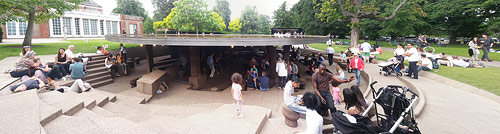
The haphazardly arranged tiers and pathways of this year’s Serpentine Pavilion offer a shady area to sit on a hot afternoon in London. Children looking for adventure charge through cork-lined gangways and leap over steps. Adults drink, read, talk and sleep – as adults do. The pavilion mutually lends itself to all of these arrangements.

The layout is not completely haphazard, it has been designed in response to the foundations of previous pavilions. And the most intriguing part of the plan is not deference to these structures, but the idea that a usable space can be arranged to the chance of historic precedence. Instead, a perfectly ergonomic building might have been honed for people to relax and play with these functional uses fastened sturdily to the concept, and how orthodox and dull it might have been.

de Meuron, Ai Weiwei and Herzog’s modest pavilion claims that we are capable of adapting to any form that is presented to us. It is better this way. It encourages us to explore; to create our own personal mental maps, way stations and games. It is a demonstration that architecture does not always need to precisely fit its function. Great – now let’s do the same thing with a new school building.

To list, or not to list the Southbank Centre, London?

John Penrose is the Conservative Minister for Tourism and Heritage. This month, he rejected a renewed application from the 2oth Century Society to list the Southbank Centre. And his department took the further step of granting a certificate of immunity for future attempts to list. This took place with the support of the Southbank Centre administration. They are keen to revamp the complex, and are concerned that listed status might seriously cramp their style.

There has been much talk about this issue. Architectural historians and culture freaks have been crying real tears of remorse over the site’s future change of form – whatever form it might take. Sixties brutalism has never been more refined and loved than on this prime piece of riverside real estate. It may not be loved by everyone, though what is? The fact that it is loved at all, however, seems important.

Aside from the issue of its architectural significance – discussions relating to Archigram, craft concrete form-work and maze like circulation spaces – there is another aspect which has been missing from the debate. The main reason for protecting the Southbank Centre is to enshrine its use class. In the current climate, if the land were to be redeveloped it may inevetably require an element of commercial use to make it pay. Older buildings that have a vibrant non-commercial use in the city are extremely beneficial, because they have already paid for themselves. For the arts to survive in such a concentrated area as the SBC, it is important that they can do so knowing there is no rent or loans to pay off – or adjacent commercial interests to acknowledge.

It would be virtually impossible these days to recreate the SBC without some kind of compromise, and for that reason we should keep it in its uncompromising existing form. A Grade II listing should be sufficient to protect the function of the site and its architectural integrity, whilst still giving the centre the opportunity to make the improvements that it seeks. Afterall, the same policy has been applied to the Royal Festival Hall, which has undergone a successful redevelopment programme. Do the SBC want to keep the other buildings on the site at all?

Book Review: London – The Unique City, Steen Eiler Rasmussen (1934)

“London’s contribution to architecture is simplicity”.

Some architects are best known for what they have produced, and some for what they have understood. There is no published portfolio of Steen Eiler Rasmussen’s built work, though we can be reasonably sure that he was an accomplished designer. His influence on post-war town-planning in Copenhagen is accounted for, and we shall return to this later. However, until the publication of that monograph, Rasmussen will remain best known as an effective communicator of simple ideas about complex towns and buildings.

London, The Unique City, is one such idea. Here, Rasmussen approaches London with some straightforward presumptions. He proposes that the historical development of London has been different to that of other major cities and that this difference has led to what he describes as a ‘scattered city’, rather than the concentrated varieties that are more common throughout Europe. In addition, he surmises that this has resulted in a vernacular domestic architecture that is particularly agreeable to him.

For Rasmussen, the driving force for this diversion from the urban-norm has been a combination of English idealism, and the strength of the City as a financial and political organisation. He describes London as a city untainted by the arrogance of rule, and free of absolutist town-planning – it has never been the City Beautiful. This is because London has never belonged to royalty but to merchants, guildsmen, landowners and bankers. The combined influence of the City’s wealthmakers, from mayors to apprentices, has always transcended the power of the Crown.

Consequently, London was assembled piece by piece by wide-eyed developers. At the end of the 18th Century it was the largest city in the world but contrary to folklore its gold was never used for paving but further speculation. Simple, cost-effective housing was London’s stock: “The English continued to accumulate riches, but they certainly didn’t spend them on the exterior decoration of their houses”. In time, the pragmatism of Georgian design, its roots in straightforward classicism, and more importantly, its lack of adornment, would become a draw for European designers of the modernist school. In this book, Rasmussen was one of the first to make this connection and in doing so raised the status of Georgian architecture a tier.

So what of this English idealism? London was originally only published in Danish and one wonders if the subtext might have been intended as quirky reportage for the amusement of his compatriots – those crazy English, with their funny domestic rituals in their rows of small houses! But Rasmussen shows compassion for the English approach to living, “The English have cultivated everything connected with daily life: they have made it an art to live in the right way”. He documents the evolution of the London townhouse, its style and function: the sober Georgian terrace; the ‘vulgarized’ house of the Victorians; and, the mock-tudor detached garden cottages of early twentieth century suburban London. In their house of choice, Londoners have moved from puritanical simplicity, to a denser version of the same with decorated floral motifs in plaster and oil, to a fantastical recreation of a medieval country retreat.

It is clear to Rasmussen that rural sensibilities abound in the English city. He sees it wherever he looks. The imperial system of measurements determines the size of the most common London townhouse, sixteen feet and six inches wide, according to Rasmussen. Feel free to measure the next one you come across. This system is derived from the agrarian units of acre, furlong, chain and rod, which were used for measuring fields – a rod is precisely sixteen feet and six inches. In describing the development of the English landscape garden, Rasmussen argues that rural England is tightly entwined with an Englishman’s image of himself, even amongst city dwellers. Londoners were as soon to riot for the protection of open fields surrounding the city as demand improvements to streets or buildings within. And country pursuits were deemed more fashionable than city culture, a very different arrangement to that of continental Europe where trends emanated from the royal courts of major cities. When Charles II opened St James Park for public recreation it was the greatest thing he could have done for Londoners – not rebuild the city, but invite the rural English landscape inside. Idealised.

Rasmussen was influential in Copenhagen as a town planner. One of his most ambitious projects was the design for Tingbjerg, a new suburb for 6,000 people built from scratch between 1950 and 1972. He led the design team which produced all of the plans for the project: every road, building and public space. His enthusiasm for English domesticity seeped into the design. It was a gentle modernist development, flavoured with Georgian London and the Garden City. Avenues of sturdy brick housing of a consistent type, generously scattered with natural parks accessed through cobblestoned alleys. It is now one of the most deprived areas in Copenhagen, rundown and crime-ridden. The project was a failure that has severely damaged Rasmussen’s reputation as a designer. Though why is this surprising when Tingbjerg was clearly at odds with his convictions? Much of Rasmussen’s writing conveys the same message – good urbanism cannot be designed by architects, it must happen naturally. It appears that he may have succumbed to the same heady notion shared by other designers of influence: that his greater understanding of the city will help him fake it. It can’t, and it never will. London, The Unique City tells us this. Perhaps he forgot?

Patrick Keiller: The Robinson Institute, Tate Britain, London

Is Patrick Keiller an architect, or is he an artist?

Perhaps this an obstinate question to ask? A man can be both, and more besides, can’t he? My answer to this is no. There are many professions where dual roles are acceptable. An actuary can also be a restaurateur, and a cabby might arrange flowers. But an architect can never make art, and an artist can never make places. One might become the other, but they have to leave their previous form behind forever. This might sound like reactionary dogma – perhaps it is – but this distinction must be made for the collective good.

Keiller is an architect who has become an artist. A thoughtful collection of works from the Tate’s collection has been given an unexpected airing alongside some historical objects, ranging from a thresher to a meteorite. These have been assembled as narrative juxtapositions to silent clips and stills from his recent film, Robinson in Ruins (2010). The result is a carefully constructed muse on the British countryside. Here presented in the aftermath of a battle: modernism in vicious conflict with our cultural rural sensibilities, with a backdrop of class-struggle and globalisation.

Yes – this is definitely art – so we can relax, no-one has been hurt.

Walking With Pepys at Moorfields, London

Samuel Pepys did not like to stand still. He was an active participant in city life, in work and in leisure. Among his outings, he records more than twenty trips to Moorfields, a public open space to the north of the City.

For many years, Moorfields was unique in London as a protected area for public recreation. Various attempts had been made to drain its swampy marshland, eventually successful, and in 1415, Moorgate broke through the wall providing convenient access for London’s cooped up citizens. The fields were not owned by the City, and moves by landowners to cultivate and build there were systematically thwarted by violent protest, acts of parliament and royal intervention. In 1605, much of the park was bequeathed to the City, and the following year the plots were formally landscaped in three sections of different character: Upper, Middle and Lower Moorfields.

Pepys’ forays into Moorfields were driven by a variety of whims. He was often found there in conversation with Sir William Penn, his friend and colleague at the Navy Board. He was always appreciative of good weather, and his fellow walkers – commenting on those that he came across: ‘young Davis and Whitton, two of our clerks, going by us in the field – who we observe to take much pleasure together’. In the evening, he watched bouts of wrestling, followed by a visit to one of the many alehouses that surrounded the park. An attempt to build a theatre at Moorfields was prevented, but Pepys found enjoyment in puppet shows, particularly Polichinelle, an ancestor of Punch and Judy, which he appreciated so much that he saw it two weeks in succession. It was the venue for Pepys’ solicitous, and ultimately fruitful attempts to seduce Mrs Bagwell, the wife of a carpenter of his acquaintance. These ambitions were in character with the surrounds as Moorfields provided the backdrop to a number of notorious brothels – Pepys refers to them in his comments on the violent apprentice riots of the spring of 1668: ‘great talk of the turmolt at the other end of town about Moore-fields among the prentices, taking the liberty of these holidays to pull down bawdy houses’.

When the plague was rife in London in 1665, the tone of the park changed, as parts became impromptu sites for mass graves. Pepys takes a morbid detour on one occasion to check whether any such burials were taking place. After the Great Fire, Moorfields, by default, provided the location for the temporary encampment of displaced citizens, ‘poor wretches carrying their goods there’. By April 1667, the City had leased part of Moorfields for seven years to build a commercial street, to be used whilst the City was being rebuilt. Pepys visits to see for himself, finding that, ‘the street is already paved as London streets used to be – which is a strange, and to me an unpleasing sight’.

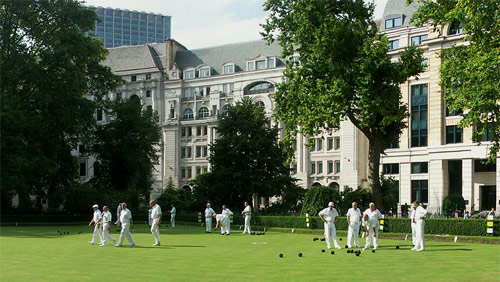
The New Bethlem Hospital was built over this stop-gap street in 1675, though Moorfields was to hold out as a place of open recreation for another century. Finsbury Square, and its surrounding streets were built over Upper and Middle Moorfields in 1777, and the Lower fields were replaced by Finsbury Circus in 1812. Today, a neat bowling green presides in the centre of the Circus, as a gentle reminder of its prior state.

The history of Moorfields is an eloquent opening line in the story of modern city parks. Its status emerged from the love-hate relationship that Londoners have with the concept of the city, providing a psychological precedent for the emergence of the public parks, open squares and community gardens that soften London. There is no need to decant to the Garden City, as an acceptable version already exists within – not planned, but accumulated as a natural expression of London’s own narrative and strong will.


John McAslan’s King’s Cross Concourse, London

King’s Cross Station has traditionally been a sober friend in relation to its shouty neighbour at St Pancras, which was always ready for a party even when it was down and out. Lewis Cubitt designed a building that looks like a station – it could be nothing else – like the sort of object that a child might place alongside a play track. The elevation of the two great sheds extruded into its southern façade to form a pair of grand arched windows has been its marker in this respect: a building that tells a simple story.

McAslan has understood the value of this. The front of the building will be cleared of its detracting modern concourse, and when the hoardings are removed we will have a clear view of Cubitt’s set piece once again. Which would be enough, but the works go further than this. The new western concourse has been tucked behind the Great Northern Hotel. It is a bold new public space canopied with a geometrically ornamented structure that is likely to make the functional modernist wince. King’s Cross has been given back its architectural heart, but like Cinderella, it has been allowed to sneak out the side door in a splendid new gown and join St Pancras at the ball.

University Plaza, East Tropicana Avenue, Las Vegas

The heat of the concrete sidewalk is searing through the soles of these cheap canvas shoes. I have been walking along East Tropicana Avenue for thirty two minutes. The directions to University Plaza were clear enough, but the presumption was that I would be driving. Now the sweat on my brow has condensed to a dry vapour, and the scent of ammonia is rising from my chest. To the north, a passenger plane appears out of the haze of the horizon, whilst another roars eighty feet over my head in its descent to the runway at McCarran International Airport. There are more landings here than at Heathrow or Charles De Gaulle, and the movement provides a diverting spectacle as I continue walking.

East Tropicana is a tributary of the Strip. It is a functional supply route, an eight-lane thoroughfare that provides a conduit for cheap labour from the suburbs. I arrive at University Plaza, a large parking lot surrounded by drab post-colonial style one-storey commercial units, tan rendered, and scan the perimeter for the object of my destination; the only coin-operated laundrette within a mile of the Strip, and one of the few places where I can wash my clothes before I make the long drive to Los Angeles. I enter and take an unadulterated pause to breathe in the moist processed air, a welcome respite from the arid heat of the street. I investigate the methodology, and make my own arrangements with a washing machine. Luckily, I am not short of quarters, a week on the road has provided well in that department, and soon my own sun-worn clothes are darkening in a pool of warm water, giving up their form to the liquid and rotation of the drum. Las Vegas was built around a desert spring, but the oasis ran dry years ago and the water that feeds the half-million residents of the city is now sourced thirty miles away from Lake Mead, a reservoir of the Colorado River created by the Hoover Dam. This water has taken a path into my own body through the ice in the whisky sodas that I drank last night, and into the sprinkler systems that feed the trees lining the boulevards of modest bungalows that surround the plaza, and now into the fabric of my clothes. Current predictions suppose that the lake might run dry within the next ten years, so a new source will have to be found.

A boy, aged about ten, is sitting on a chair opposite to me. He is rocking his head back and forth and his pupils are lodged at the top of his eyelids. He sees nothing but hears everything; the whirring and sloshing of the machines, the clunk of the coin-machines, the change of air pressure as the door swings open and closed, and the soft chatter of the clientele. I make up my mind that he is a fixture here, that this laundrette provides his sensory world and his daily routine. He cannot be moved by the flashing lights or the post-modern architecture of the Strip, but for him, this small interior space is Las Vegas. The young woman in cut-off jeans, whose teenage son is helping to fold her evening work clothes into a carefully separated pile has a different understanding of the city, as does the middle-aged man whose branded coloured shirts now hang neatly from a mobile rack.

But the blind boy is smiling, he is content here. We are behind the scenes at Las Vegas, and for the first time I feel relaxed in this city.

The Big Yellow, Lewisham Way, London

Big Yellow Storage buildings are most often glimpsed across a flyover from your car as you stutter between speed cameras on one of London’s internal arteries, though some have crept further into the city. Fulham Power Station has been converted utilising the large transformer chambers as a halfway house for almost-junk. A flame under these mounds of copy-files and furniture might be enough to drive the turbines again, but the guarded artefacts remain safe until the time that a family returns from Abu Dhabi, or an indemnity issue calls for the right paperwork.

The newest Big Yellow has been built on Lewisham Way at the site of the old Pyne Brothers department store. It faces Deptford Library, now used as artist studios and gallery, between Lewisham and Goldsmith’s College. The building presents ten fully glazed bays that provide a shallow horizontal view of an internal corridor where a sequence of padlocked yellow doors silently face out of the building towards the street – like a row of changing cubicles at the public baths. This is an odd visual relationship. Is it for our benefit that the narrow passage parades itself so unabashedly?

We have to imagine what we cannot see. We cannot see a woman running her hands across a pile of exotic vegetables, weighing them up and sighing speculatively. We cannot hear the sound of two sibling rivals arguing over whose pocket-money was best spent at the sweet counter. We cannot see an artist with splattered overalls darting across the road with a hot pattie in brown paper to his mouth; nor the student with fragrant espresso nervously scanning her notes and stroking her phone.

We cannot see, hear, smell, touch or taste much active city-life at all, and any number of yellow doors is no substitute for this.