InTrivia

Paintings (1996-2001)

I used to paint.

Transient States:  Extraordinary details of the world we inhabit are often reduced to the mundane within a culture that is saturated by the extraordinary.  The ‘Transient States’ series is an attempt to re-address the balance. Dead insects are commonly found objects that provoke a range of reactions. Presenting the remains of an insect in an art context is a way of lending increased status to the object, and reclaiming the extraordinary nature of the subject matter. The image of the insect is deliberately obscured by the chosen medium: gloss paint on a matt surface; a method which is designed to encourage the viewer to explore and engage with the painting on a more intimate level. It also emphases the transient nature of the insect’s existence. (1996)


Language of Violence: The “Language of Violence” series of paintings concerns the cultural role of violence in society, specifically with regards to language, and the relationships that exist between people in violent confrontations. (1997)


Human Landscapes: This series of paintings was produced after moving to, and working from coastal Pembrokeshire. The area is awash with landscape painters who champion the natural diversity of the landscape as an inspiration for their work. “Human Landscapes” is a response to traditional rural landscape painting. My observation of the landscape in rural areas is that of human intervention: field patterns, grazing moors, coastal mines and footpaths. Just like the city, we have formed the rural landscape through our actions and industry. These paintings are of local sites of rural beauty that have been permanently tainted by a singular human event. In each case, the painting represents the scene of a notorious local murder. (2001)

Strawberry Hill House, Twickenham

Among the corridors with hand painted wallpaper, flat and graphic and the oozy gloss painted walls. And the brilliantly sanded bleached wood floors and ceilings with perfect gold highlights. And the sealed ex-cloister filled with formica café furniture. The deadened matt finished surfaces, and the cheery volunteer staff. And the stage sets with safety and access compliances. Among the desolation.

There is a room that is full and layered with gloomth and objects: stacked furniture, carpet rolls, boxes of files, clothes rail and hangers, unpainted paneling, histories of wall coverings and darkening ceiling. A palimpsest. It is comforting, a place to pull out a chair, dust it down, sit and read a gothic novel from cover to cover without flinching. It is a room that can tell a story without the aid of the human voice, a room that draws you in and shuts the door behind you. It is the only room in a house that was once full of rooms.

In a bright, bright house, there is a dark, dark, room

The Pantheon Paris: Urban experiments, a stopped clock and the practice of everyday life

In the autumn of 1981, a group of Parisian teenagers goaded each other into staying the night in The Panthéon, the national monument to French cultural heroes in the Latin Quarter of Paris. It was an act of bravado, a dare, a double dare. At the end of tourist’s opening hours, they squeezed into a good hiding place inside the building and waited until it was closed. After the security guards had locked up for the night, they emerged with the whole place to themselves. It was an act of infiltration that was exhilarating, addictive and surprisingly easy. It was also the first act of an underground cultural collective known as UX (Urban eXperiment).

Paris is a city with a diverse network of underground tunnels and interconnections – catacombs, drains, service tunnels and shelters – some of which link up with the basements of public buildings and institutions. There has been a long tradition of subversive use of these underground spaces in Paris, from willful exploration to hedonistic partying. It is an obsessive hobby for some, ‘cataphiles’ as they prefer to be known. They take pride in developing an inside knowledge of the underground networks trading master keys and maps with each other in clandestine meetings.

UX have been influential within this subterranean clique. During the thirty years of their existence the group have used their expert knowledge of the city to instigate some very surprising cultural and spatial initiatives. They have staged secret theatre performances in The Panthéon without permission, and art exhibitions in the catacombs. They have held film festivals, including Urban Deserts, based on the hidden areas of the city that they have become so familiar with. The venue of choice for this event was a little used screening room beneath the Palais de Chaillot, which they furnished with a bar and dining facilities. All of these cultural actions were un-publicised and largely unknown to the authorities and owners of the buildings.

A subgroup of UX, called Untergunther, has an unusual specialisation. From years of urban exploration they have identified Parisian cultural urban artifacts that have been neglected and left to decay by the state. Instead of just observing and moving on, they have planned elaborate conservation projects without the need to ask permission. A disused metro station has been lovingly restored for the benefit of no one in particular other than those other cataphiles who might stumble across it in their adventures. Likewise a First World War air-raid shelter and a twelth century crypt have been tended to. Perhaps Untergunther’s most remarkable act of conservation occurred at the Panthéon in 2006.

The idea first came to Jean-Baptiste Viot, a clock-maker by trade and founding member of UX, at one of the group’s performance events at the Panthéon in 2005. He took the opportunity to examine the building’s impressive nineteenth century Wagner clock, which had been broken for over fifty years. Viot came to the conclusion that with time and effort it might be repairable, and so he assembled a team of other UX activists and set about the task. Their first act was to construct a temporary workshop in the dome, concealed by the typical wooden crates that were already littered around the building. The workshop contained chairs, tables, bookshelves, sofas and an area for preparing food. Makeshift drapes enabled a degree of temperature control for the careful work they were about to embark on, and electric cables were connected to the grid to provide lighting, power for tools and web access. For nearly a year the eight members of the conservation team worked through the night on the clock, then left before the morning without being detected. The clock had become rusted due to neglect so each part of the device had to be carefully removed, cleaned and polished before reassembly – a painstaking and laborious process. The pendulum bob and escapement wheel of the mechanism were missing and broken, so these were reconstructed and the clock’s broken glass front plate replaced. The process was intended as a careful act of conservation in which as much as possible of the original device was left in tact. On 24 December 2006, the work was complete. The conservation team left the workshop for the last time and the clock worked once more, chiming at every quarter hour – much to the surprise of the Panthéon’s administration.


There is cultural value in the Panthéon’s built form, its construction between 1758 and 1790 required innovative techniques. It was one of the first buildings of this scale to use reinforced iron bars embedded into the structural stonework to support its slender columns and wall structures. However, its most striking value is as a last resting place and monument to the strength and influence of French culture as created by their most auspicious innovators. After its conversion from a church to a mausoleum in 1791, only those deemed worthy of significant status in French culture have been interned at The Panthéon, including Victor Hugo, Voltaire, Rousseau and Marie Curie.

UX are very much aware of this, which is perhaps why they have developed such an affinity with the Panthéon, returning to it again and again with new ideas for interacting with it. Their relationship with the building has developed over time in a way that is different to how others experience it. And because of this, they have acquired a particular sense of ownership. But their understanding of ownership does not fit into the conventional political or economic model.

When we speak of cultural heritage, we generally speak of it as belonging to someone: it’s a nation’s heritage; it’s a region’s heritage; it’s a city’s heritage. This manner of speaking can lead you to believe that all cultural heritage has an owner. In truth, heritage only has managers.
(UX, 2012)

With this attitude, it is easy for UX’s members to feel emboldened enough to act as the Pantheon’s manager, if only for a brief period of time whilst they are experiencing and contributing to the building in a way that is personal to them. When they are using the space, it is theirs. It is a part of their own heritage on a range of levels that are all important: as an integral part of the history of their own group, their city and their country.


UX’s programme reminds me of Michel de Certeau who came to prominence in May 68 as a champion of the student rebellion, and has applied a Freudian psychoanalytical approach to his philosophical investigations into place and social interaction. His most influential work, The Practice of Everyday Life, was originally published in 1980, just a year before UX’s first youthful foray into the Panthéon at night. de Certeau attempts to make a critical argument relating to how we experience the use of spaces and objects; how individuals develop ritualistic behavior patterns that make their experience of buildings and the exterior areas of the city their own. It is this appropriation of the everyday by individuals that is interesting and essential for the functioning of society, though this personal relationship is often challenged and restricted by enshrined ownership. However, expected use patterns that have been imposed by organisations through ownership can be subverted and changed. de Certeau suggests that it is this act of subversion that coerces society to function more productively in the pursuit of a collective and private happiness.

The purpose of this work is to make explicit the systems of operational combination which also compose a “culture”, and to bring to light the models of action characteristic of users whose status as the dominated element in society (a status that does not mean that they are either passive or docile) is concealed by the euphemistic term “consumers.” Everyday life invents itself by poaching in countless ways on the property of others. (de Certeau, 1984)

Here de Certeau deliberately separates the term “users” from “consumers”. He presents consumers as a collection of individuals that are complicit in their use of “production” (the urban environment, retail goods, the media) in a way that has been coerced by those that have produced it: the “dominant economic order”. Whereas a user may employ “ways of operating” that are varied in order to reappropriate production in a way that is personal to them.

The Practice of Everyday Life is summed up with a discourse on time, and history. He sees place as a complex strata of conditions that have been laid down over time, a cultural palimpsest, with a “fictive” character that immerses us as individuals, and can be added to. A modern technocratic approach to the organization of politics and production ignores this in preference for entirely new modes of production and organization.

Beneath the fabricating and universal writing of technology, opaque and stubborn places remain. The revolutions of history, economic mutations, demographic mixtures lie in layers within it, and remain there, hidden in customs, rites and spatial practices. (de Certeau, 1984)

So for de Certeau, it is the combined programmatic effects of finding personal and subversive ways of using place, and an emersion in the subtleties of historic cultural practices that may provide an impetus to break through the restrictive organisation of place and ownership that have been imposed on society by dominant producers of culture. The result may be an artful, and profoundly personal relationship to our environment that is empowering, and productive. And it is here that we can return to UX, and a building.


UX’s relationship to The Panthéon appears to be artful, productive and empowering in just the way that de Certeau might approve of, and probably more so than any other organisation, including the public body that oversees its official management, Centre des Monuments Nationaux (CMN). UX’s members have scoured the building: every room, corridor, alcove and surface, and have familiarised themselves with its layout, surveying alternative places of entry, exit and escape routes. They have looked for details and objects within it that can be used as part of their projects. They have formed a bond with the building that has engendered in them a profound sense of ownership on their own terms, and through this they have adopted a self-appointed managerial role. So in this frame, it was perfectly natural that a clockmaker should see a broken clock, and decide to repair it. Of course, this leap of judgment requires a subversive program in the context of conventional structures of ownership, but it is certainly not a revolutionary act.

Through their conservation subgroup, Untergunter, irrelevantly named after two guard dogs encountered on a memorable excursion through unnamed passages, UX adopt a proactive managerial role in many of the places and objects of culture that they encounter in their travels. They have developed a sophisticated philosophical approach to their understanding of the heritage that they encounter. This takes into consideration minor heritage and that which is “non-visible”. For UX, these small fragments of the past are experienced at close proximity in a way that is meaningful. It is minor heritage “that touches individual’s most directly” – layers of localised cultural historical knowledge, which UX feel motivated to bring back into focus. So when the group encountered an underground First World War bomb shelter that was starting to crumble into the tunnel, they examined it, formed a bond with it, conserved it and used it in their projects. They took ownership, where nobody else had, though it was not their property.

So UX argue that heritage that has acquired a strong personal meaning to some people is culturally more valuable to society than heritage that has remained non-visible. However, non-visible heritage is embedded with latent potential; ‘Non-visibility need not be permanent. It is only non-visible for a time’. This is embedded into UX’s approach to conservation – but if non-visible heritage is to become visible, to enable it as a mediator of cultural meaning to an individual or many, then who is likely to make this happen? UX argue that there is an inherent problem with the hierarchy and organization of conservation. It is not spread out evenly, but a group is designated by the public to take on that role on their behalf. And so, the majority of people who come across a piece of non-visible heritage and feel that it should be preserved take no action as they lack a mandate. They do not see that they have ownership of the heritage, despite the fact that they might be one of only a small number of people who are aware of, or care about its existence.


Would it be fair to describe UX, with their method of reacting to existing spaces, as bricoleurs? They seem to relish their temporary occupations instinctively, and creatively. And perhaps they enjoy the freedom of operating in this way, without the constraints that are characteristic of a modern approach to dealing with space: planned, strategised and pre-authorised.

Like everyone, UX are a product of a cultural environment. They have acquired a deep subjective understanding of the place where they live that has taken in the history of its culture, the physicality of its structure, and philosophy of its thinkers. However, unlike most groups or individuals who go about their business led by restrictive urban and political structures, UX operate a free program. Their actions have become an unencumbered devotion to space, which has accumulated subjectively during their travels and interventions: a careful and gradual series of explorations.

UX’s understanding of place seems to be phenomenological. They are not interested in respecting allotted functions, and established programs. Instead they wish to engage with the space in a creative and playful way. They learn through experience of their senses and intellect, and react as bricoleurs to their surroundings: reforming them, repairing them, and making them their own. And in the terms that Michel de Certeau has laid down, UX are ‘users’ rather than ‘consumers’ of production.

Users make (bricolent) and infinitesimal transformations of and within the dominant cultural economy in order to adapt it to their own interests and their own rules.  (de Certeau, 1984)

Perhaps this is a useful model for designers to take note of? de Certeau points to a way of urban organisation that is less prescribed than classical or modernist principles of planning that rely on rigid programmatic and technological structures. Buildings and cities are becoming hyper-engineered in a way that is forcing individuals to bend and adapt to a pre-planned program, and this is facilitated by the political principle of ownership. Architects happily play into the hands of this process. Buildings and masterplans that are designed with a rigid functionality attached is appealing to the designer who is looking for a way of influencing and controlling the urban environment beyond that of aesthetics. UX have demonstrated that it is possible to subvert this positively, and in doing so have added something significant to the city. Could architects moderate their design approach to promote this way of experiencing space in our cities?


POSTSCRIPT: SO, WHAT BECAME OF THE CLOCK?

When the clock was fixed, having discussed it carefully amongst themselves, UX decided that they should approach the Director of the Panthéon, Bernard Jeannot, to inform him of their actions. At first he did not believe them. But they showed him the working clock and the hidden workshop, and he was forced to accept that their far-fetched story was indeed true. UX advised him to take credit for the repair. They would be happy to sink back into the shadows of the catacombs without fanfare – the important thing was that the clock was repaired, and it would continue to be looked after and function. However the Director did not take that advice, he told lots of people, and was promptly given the sack. His deputy, Pascal Monnet took over the Director’s role and with the CMN instructed lawyers to seek criminal damages from four members of Untergunter’s conservation team – at one point seeking a jail term. The case of the French government vs. UX became a celebrated story in the French national press, giving the secretive group some unwanted publicity. The case reached the courts on 23 November 2007, and was thrown out – the president of the tribunal, Eric Meunier, described the prosecution as ‘incomprehensible’. Apparently there is no law in France against the repair of clocks, and neither is there for trespass on public property.

The clock itself is no longer working, stuck at 10:51am. On the 26th December 2006, when the Pantheon opened again after Christmas, Monnet, instructed another clockmaker to silence the clock by breaking it. Fortunately, it is not in the nature of clockmakers to break clocks, and so he simply removed the escapement that had been repaired by Untergunter, and put it in a cupboard in an office of the Panthéon. Two days later, it found its way back into the possession of UX for safekeeping. Meanwhile, Untergunter were already formulating plans for their next covert act of conservation – though we are never likely to learn anything about it, unless we ourselves become catophiles, and stumble across it by chance in the catacombs.


The above essay is an edited excerpt from a longer article.
Book Review: Edward Durell Stone – Modernism’s Populist Architect by Mary Anne Hunting

Edward Durell Stone is no longer a household name, though Mary Ann Hunting’s painstaking biography of this popular American architect of the post-war period re-informs us of his prior esteem. Stone nurtured his career with Beaux Arts training and a traveling European scholarship. It is neat that his direct contact with both the emerging international style and antiquity at an impressionable age resulted in such a romantic hybrid of the modernist and classical aesthetic in his later career. A preamble through Stone’s early work includes lovely drawings and photographs of authentic white modernist houses, a refreshing combination of works for wealthy patrons and low-budget architecture for mass consumption: plans sold in lifestyle magazines for 3 dollars a pop.

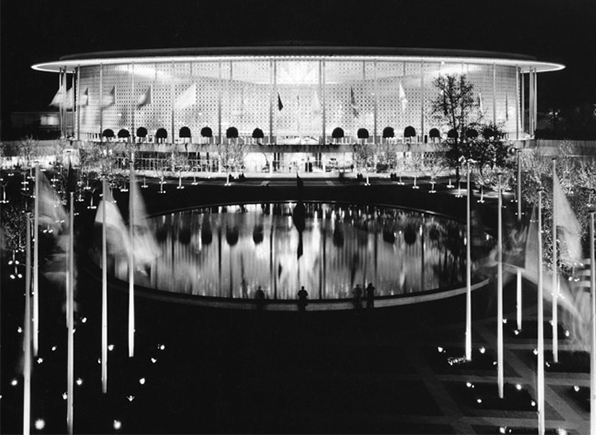
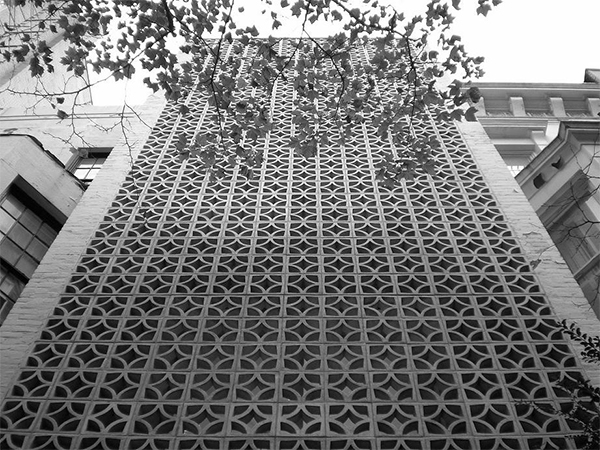
The two major projects that gave Stone renown in his home country were the United States Pavilion at the Exposition Universelle et Internationale in Bruxelles (1958), and the American Embassy in New Delhi (1959). It is here that his experiments with punctured blocks were first given a comprehensive public airing. The motif of the quarter-divided circle in his grillwork became Stone’s signature. It appeared in many of his buildings, unchanged, and much later in a large quantity of suburban front walls in Britain – it is a pattern we should all recognise. Some of his facades, such as student accommodation at the University of South Carolina (1965) and his own house in Manhattan (1958) are almost completely clad in this same patterned block. Hunting cites this as one of the reasons for Stone’s critical demise: his attempt to create a recognizable architectural brand came with the dire risk of self-pastiche.

At his best Stone designed with the same spirit as Louis Kahn, taking the principles of modernism and blending with historical reference to create buildings with popular appeal. Where Kahn played with form and materiality, Stone was obsessed with layering and layout. He dubbed his approach “new romanticism”, and believed that the design of buildings should “be in the accumulation of history”. No wonder he was never entirely accepted by the dour modernist critics of that era, and for this reason Hunting is quick to position Stone as a precursor to post-modernism. Venturi is name-checked regularly in her argument, though Stone was not about complexity and contradiction – he embraced many of the principles of modernism, his plans were rational and fully formed. His work was an attempt to make modernism prettier, to bring back the decorative element. If anything Stone’s buildings remind us that post-modernity did not begin with the burning of a chair or a visit to Las Vegas, but an accumulation of dissatisfaction with an aesthetic. Stone partly understood this and used his career to help buck a trend.


The Production of Place, University of East London

The MA Architecture, Sustainability & Design department at the University of East London held a conference called The Production of Place. Keynote speakers included the bestselling author Iain Sinclair, Chris Pyke from the US Green Building Council, the Chilean architect, Alberto Moletto and Tony Fretton. Topics were varied/specific, rather than categorical/generic and influenced by three given themes: Global knowledge via local place; ‘Making’ and ‘doing’; and, Insecurity in and of places.

As a student of architecture, it is useful to grab some insight into the cultural environment in which we will soon be launching ourselves. The history and politics of development is complex and obtuse. The Production of Place can often seem like a fierce and muddy battleground in which the architect can only hope to play a positive role. As this influence is often hard to obtain it is prudent to spend quality time discussing why, where and how the act of design can make an impact, so that we are ready when the time comes.

In between the vigorous debates, a number of students at UEL, myself included, took part in a series of four-day ‘live research’ workshops. Alberto Moletto and Catalina Pollak engaged students in the task of using handmade technology to create surprising acoustic interactions in public places. Alan Chandler’s workshops resulted in a series of hard concrete sculptural casts of soft comfortable places.

I took part in a workshop led by the artist Richard Wilson, with Raphael Lee. A day was spent on site at the Woolwich river crossing. We collected as much raw data as we could – sketches, photographs, imprints of surface and edge. We presented these individual explorations back at the studio, but our conversations meandered. Richard suggested we stop talking and warm-up by making some basic forms using the stacking chairs that we were sitting on. By the end of the day we were still building. The floor was covered with teetering towers and tunnels hastily fastened with tape. By the following day, we had forgotten the details of our personal site investigations and had become focused on an emerging collaborative task – to use the chairs to create a large sculpture in the space that would reference the foot tunnel at Woolwich. Every chair from the Architecture department was gathered up. Groups of 17 were laid horizontally in circles, and fastened with cable ties. The circles were lifted vertically and fastened together generously. As the chairs creaked and groaned we cleared studio detritus out of the way to gain an unencumbered escape route, but the structure held.

We were happy with the end result, it filled the space very well. Most importantly, we learnt some lessons that touched on the central themes of the conference. The piece of work that we produced together was as much to do with the place we were working in as the place we had visited. Through making and doing, rather than personal expression, we found a solution that encouraged us to work well together. And it was the insecurity in the form, its potential for collapse that gave the final piece a lot of its presence in the studio. It was a great end to the term, and the sculpture was still standing in January when we returned to campus.

(The Production of Place was organised by Roland Karthaus, Adam Chandler & Juliet Sakyi-Ansah, and the exhibition was organised by Michela Price – for further information, please visit the website: www.tpop2012.co.uk).

The Prickly Pear: The National Centre For Popular Music in Sheffield

Here we go round the prickly pear
Prickly pear prickly pear
Here we go round the prickly pear
At five o’clock in the morning.

Between the idea
And the reality
Between the motion
And the act
Falls the Shadow

Between the conception
And the creation
Between the emotion
And the response
Falls the Shadow

Between the desire
And the spasm
Between the potency
And the existence
Between the essence
And the descent
Falls the Shadow

The Hollow Men, T.S.Elliot (edit).

The Distance Between an Idea and its Fruition at The National Centre for Popular Music, Sheffield.

All major construction projects start with an idea that is driven by one person or a collection of like minds. Tim Strickland’s idea for The National Centre for Popular Music (NCPM) was enthusiastically received by a steering group at Sheffield City Council looking for a flagship addition for a new Cultural Industries Quarter (CIQ) planned to rejuvenate a rundown area of the city.

An idea with strident political backing quickly becomes a project in need of funding. A non-profit company, Music Heritage Limited (MHL) was created to take ownership of the project, its board made up of cultural leaders, musicians, representatives from Sheffield City Council and a new Chief Executive – Stuart Rogers, a successful theatre manager. Initial grants totaling £1.5m were awarded from the National Lottery to develop a brief through feasibility studies and a business plan. These first reports were convincing enough to attract major funding from the Arts Council (£11m) and private investment.

An open architectural competition was run by the RIBA, with the contract awarded to Branson Coates Architecture. The winning design was a striking assemblage of four metallic drums expressed simply in plan form as four circles around a cross. The building started on site in June 1997, and was completed in September 1998 on time and on budget. Reviews in the architectural press were flattering.

So far so good – to get a major cultural project such as this instigated, funded, and completed with good will was a major achievement. However, this apparent success was short-lived. The NCPM suffered significant financial losses in its first year of operation. Projected targets of 400,000 visitors a year were not met. By October 1999, a new Chief Executive had been appointed to run the Centre who in turn quit in January 2000 to be replaced by City Council Director. By this point MHL were in administration, unable to pay their creditors, and the NCPM was finally closed in July 2000 just 22 months into its existence. The building was sold to Yorkshire Forward for £1.8 million in July 2002 and was refurbished for Sheffield Hallam University as a student’s union building.

The National Centre for Popular Music was not an idea without success. It assembled the required political will to make the project real. It utilised the strength of an engaging concept to attract good funding. The construction phase of the project was difficult but ultimately triumphant, and the end result was a building with merit that people responded well to.

Perhaps the failure was in the idea itself – not necessarily the concept of the NCPM but its function within the CIQ in a run-down area of Sheffield.

The division of urban districts into strictly defined use classes can sometimes be the undoing of the city. It can restrict diversity and prevent other potentially successful functions from flourishing.The idea behind the NCPM may not have been such a bad one, but once in the hands of politicians, city planners and cultural bureaucrats it became a different entity to serve a different purpose – a catalyst for urban regeneration and a regional talisman for central government arts funding. Left to its own devices and with modest financial backing it might have found a home elsewhere – a different place or a different city. It might have started small in a refurbished building and expanded naturally as its reputation spread and its management gained experience. It was set up to fail by people who had their eyes on different prizes when all it really needed to do was celebrate popular music in a way that people could relate to and enjoy. Did those involved lose sight of this primary purpose early in the journey? If so, then this could be the reason the golden apple became a prickly pear.

Midtown Sleeps

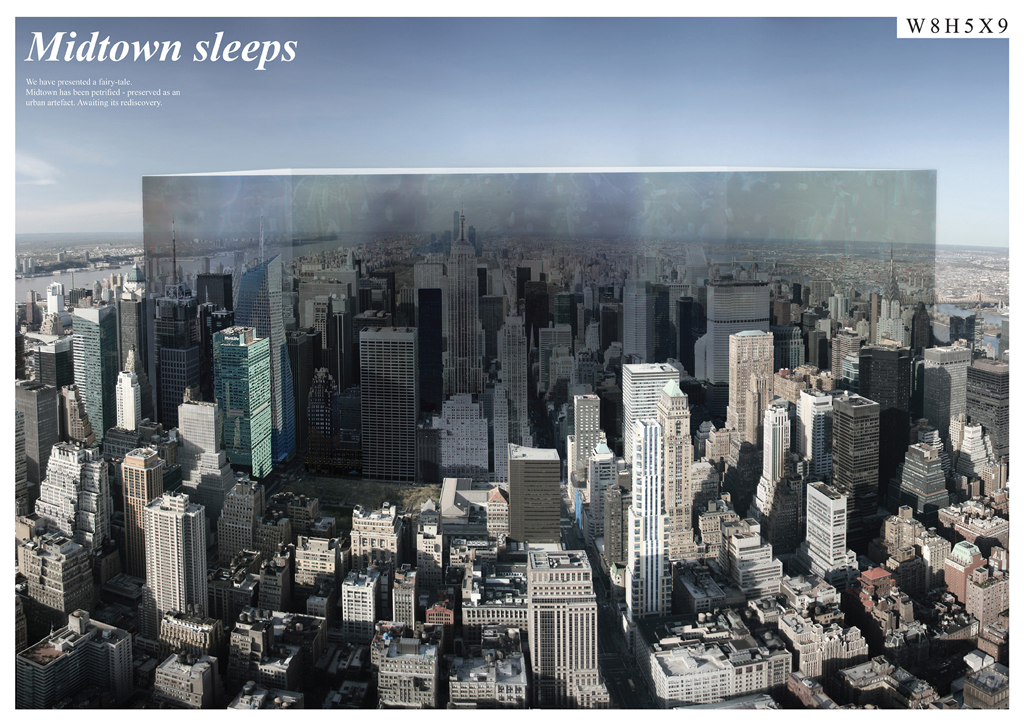
Manhattanism is the architectural doctrine of density, height and a Coney Island sense of commercial invention. It has been New York’s major contribution to world culture. For years, New York designers and theorists have struggled with Manhattan. The Commissioner’s grid has been its formal master and the Manhattan block has acquired mythical status. There have been attempts to break the grid – Robert Moses, Le Corbusier, Clarence Stein and others with superhighways, superblocks and garden cities – but it now has too many champions, and its heritage is too ingrained in America’s collective psyche. Through the grid, the city ebbs and flows – but gets denser all the time. So if attempts to pacify or restrain Manhattan are destined to fail, then why try? The city will change, but it cannot be cajoled. Designing Manhattan is anti-Manhattan. Instead, our approach to this project has been to present a fairy-tale. We have hypothesised a future scenario that has downgraded the urban value of Midtown Manhattan. The city has changed through economic necessity and social upheaval – not through design. The Financial District has broken free, an independent city state, and Harlem has risen to become a major economic centre. Meanwhile Midtown has developed a crisis of congestion, becoming a dense urban slum, a walled city.

We see the cultural value of Midtown Manhattan as a city artefact. It is a unique assemblage of architectural bravado, a defining urban moment. But Midtown is at the whim of powers beyond its control, the same powers that created it. It is, perhaps, destined to be destroyed by Manhattanism. To highlight this irony, we have proposed an intervention.

We have acted as curators. We have cleared Midtown, and assembled other related urban artefacts that are under similar economic pressures – The Empire State Building, McGraw-Hill Building, Flatiron, UN Secretariat. When the collection is complete, we have encased the entire Midtown area in a block of solid glass. Petrified.

Midtown is now a singular urban object, preserved, and immune from outside pressures. It is not dead, but is sleeping. Awaiting a time when it might be rediscovered again.

New York City Vision – Competition

A Poem called Architecture

A room with deciduous walls betrays
The expectations of hauled feet, pushed
Through distance towards safe ground.
Unsteady murmurs, now hushed,
And gently patterned, join waves

That resonate in lithe air. The waning sound
Of breath and function slowly calms
The song to fade, and the light that cuts
Down all other senses is naturally laid.
This bright shine is a conqueror of space. It routes

Its way through narrow canyons with arms
Of stray ambivalent energy made
Generous and tender, like the eloquent touch
That grips a shoulder or holds a brow
In warmth when need is laid out raw.

Small dances over dark boughs
Cast flecks of lime on beaten mulch,
Laden like the London stones which poor
Travellers dream with, though bright dreams sleep
Too well. The rugged close cannot keep them

Safe but absorbs desire without judgement
And carelessly reshapes it as root and stem,
Whilst all marks wither. But dry time seeps
Into moist gullies, forming structure like wet cement
Until the roof is raised above the players hall,

Where a symphony chimes with faint
Regards, a sentimental composition of stone and wood
Placed with cool exact restraint.
And the light that cuts these upright walls
Obediently lies the way it should.

Bothered by a small detail at the New Court, London

In living memory, though not my own, the greater part of the City of London was a dense collection of narrow lanes containing a variety of buildings that were useful to a wide range of people. Mixed-use development before the phrase had been uttered. Banking was present in the City – the Rothschilds have operated from this site at New Court for 200 years – but now banking is omnipresent.

And omnipotent. My approach is observed closely. Not quietly by cctv, for my own protection, but aggressively by large men in long coats (for the protection of others). No mind, as I can enjoy the architecture regardless, and particularly the rather fine painting that has been generously hung behind glass facing St Swithins Lane. I notice an imperfection in the ramp adjacent to the façade, and crouch down to take a closer look. Its sharp metallic edge has been concealed with a waspish plastic cover. I take a photograph with my phone.

Large shoes and the hem of a coat appear beside me alongside the defect. I am moved on after a curt exchange, having missed the chance to take a closer look at the painting, which no longer seems so generously placed.

It was a small detail, but it bothered me.

Drumming at Gillett Square, Dalston

Gillett Square is not a traditional London public square of the Georgian or Victorian type. Darkened bricks and clean oil painted moldings do not face a railed lawn; shiny plaques advertising professional services do not appear on sturdy gloss finished doors; and no office or council worker sleeps through their lunch break on a memorial bench.

It is a square of remnants and additions. It has been carved out of the detritus of a backyard and forced into shape. Backs of buildings have been layered to create commercial fronts. A derelict wall is left as a feature. Fresh and tired sidle up against each other, looking to avoid confrontation though not always succeeding.

It is contemporary. Nineteen drummers have occupied the space, a temporary addition that changes the square’s spatial and social dynamics. The arrangement of drum kits in plan form illustrate the ergonomics of space, and this is also how Gillett Square functions. Its informality encourages change of use, and the people that occupy the square are able to successfully manipulate its function, and are happy to do so.