InTrivia

Zaha Hadid, Roca Gallery, London

On my arrival at Zaha Hadid’s new gallery for Roca, Ariel appears in her contemporary apparel of black pencil skirt and tailored white blouse. She speaks to me of the watery world I have now entered, where the amorphous spaces have been imagined from the formation of water molecules, and ambient rushes, squirts, drip-drops and sloshes fill my sound sense. After this encounter with the nymph, I wonder if I should kick off my shoes and swim through the gallery, darting around the shiny white rocks of Siza, Moneo and Chipperfield, like an angel fish looking for safety in the cover of the reefs.

But then it occurs to me that I am as dry as a bone. And besides, what is the shape of water anyway? This space could look like a jam jar and the analogy would still be intact.

In my search for water, and to console myself, I retire to the customer toilet which reveals the only truly functional example of Roca’s work that is on evidence here. I am reminded of my own lack of weightlessness when the cantilevered bowl groans and creaks from my presence.

Josiah McElheny: The Past Was A Mirage I’d Left Far Behind, Whitechapel Gallery, London

The mirror is often used as a literary metaphor. Its powers of reflection, refraction and subtraction just prove too tempting a device to leave on the wall. It is also an object with a number of practical functions. Brunelleschi reportedly used a mirror to develop his theory of linear perspective, and the great painters relied on them for the production of self portraits.

At the Whitechapel Gallery, mirrors placed at angles to each other neatly divide abstract films into simple topographical parts. Here the mirror is a literary device: it changes the narrative of the film, a further level of abstraction. It is also practical device for slicing and rearranging the coloured light of the projection.

But where is the reflection of the artist? He doesn’t appear to be in the rather tidy carpentry that provides the structure for the work; the mirrors themselves are placed in such simple positions that they appear to have arranged themselves. The films are the works of others that have been selected by someone else.  It’s not until I come across the last exhibit that I find a potential answer. Opposing infinity mirrors have been affected by the natural curvature of the glass, giving the appearance of the repeated space between them arcing in a circle out of view. Perhaps Josiah is on the other side of the circle?

Richard Green Gallery, Bond Street, London

Bond Street and its tributaries are a fierce arena for the combative art of aggressive spending. Liquid and very disposable incomes are swiped into the coffers of glittering stalls. A steady trickle of trinkets, finery and the most desirable of objects swap ownership, but rarely exchange hands as these are not items to be handled, at least not very often.

Richard Green, the established purveyor of 20th Century art to individuals with a good head for investment and the assets to afford good taste, has opened a new outlet at number 33 next to Sothebys. He has chosen to dress his stall with the neoclassical trappings of the Adams architectural encampment. An Helenic bas-relief adorns the bronze framed stone facade, a scene from the Odyssey representing the birth of modern art, a bold reinterpretation of the avant-garde as renaissance. Perhaps this context was a pill too bitter to swallow on its own.

Inside, celebrated naive scenes of working class industrial gatherings are given pride of place alongside the revolutionary introspection of the abstract expressionists. “How much does an Auerbach go for these days?” was the question that I overheard. An assistant rummaged around the back of the work, presumably looking for a barcode but revealing a simple price tag, “this one’s is one million, one hundred”. “Fascinating” was the reply, and indeed it was.

The Occupy London Camp, St Paul’s Cathedral, London

Wren’s church of 1697 has become a defining statement of the renaissance in London; a barroque pin-point of taste and order within the sprawl. The old Norman Cathedral had fulfilled a dual role; as well as a place of worship it was also a place of secular gathering prior in the pre-fire City. An abundance of market stalls huddled around its buttresses where pamphlets were distributed and political preachers lectured the masses.

An invitation to Occupy London brings me here today, and this same image of the old cathedral comes to mind. I am welcomed by someone thrusting a paper into my hands, The Occupied Times, second edition. A congested mess of tents pushes up against the building: mostly places of dwelling but also tents offering goods and services – food, t-shirt printing, massage, books and an internet cafe.

Paternoster Square is cordoned off, but its perimeter buildings are also covered with printed posters. This is an encampment of communication. Impromptu discussion groups pontificate and headstrong preachers deliver personal sermons from the steps of St Paul’s for the amusement of geographic and lifestyle tourists.

Occupy London is an exuberant situationist exploration of the medieval. An historical renactment designed to jolt us into an inherited cultural ethos of shared language.

The Ambassadors, Hans Holbein the Younger, National Gallery

I am alone with the Ambassadors.

I have been trying to catch the eye of Jean de Dintevilles but it rests firmly on the Adoration of the Kings. Likewise, the Bishop of Lavour looks straight through me towards the Holy Trinity. Neither man can be adverse to the eyes of strangers but their demeanour is of non-engagement. Are they upset or just focussed on other matters?

More eyes now, this time globes in three dimensions darting across more globes in two. Searching for narrative and marvelling at fibrous brushwork. Closer, to the extreme right and then further away – murmurs, soft discussions and the intonation of conclusion. The only clearly audible voices are those of children.

This painting is now far from Jean’s house in Polisy and its form and purpose have changed. A wilful expression of pride, power and influence. A projection of real human energy which at one time was hyper-visceral, has now been snuffed. What remains is vibrant colour and a trick of the eye.

Signs invite us to escape into the artwork and so I sit waiting for an emergency to arise, but nothing happens. I am now just alone, and it is time to leave. I have not been able to look into the eyes of the Ambassadors. It is, perhaps, no longer possible.

OMA/Progress at the Barbican

Is progress a quantitative or qualitative measure?

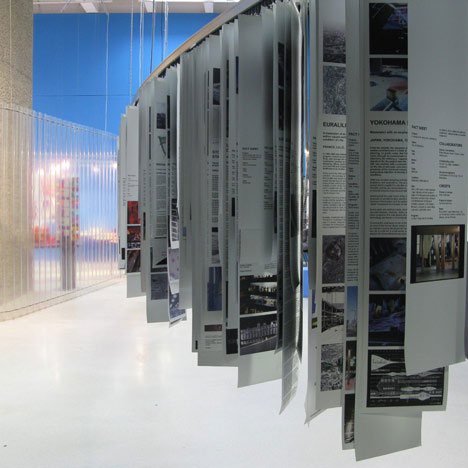
Koolhaus has been laid out bare at the Barbican. Presented here are 29 pages of a fax to Arup about the structure of the CCTV building,  48 floor-plan maquettes for a plinth at the National Art Museum of China,  33 drafts of an unfinished book about Lagos, 20 cultural comments, 7 ideas to change the world, 279 project banners, 3,454,204 images from OMA’s server and an array of similar artefacts seemingly swept up from the studio floor.

Objects, customs, habits, and ways of life must perish so that the authentic human being can live.

This quote sets the scene. A problematic statement that in some ways represents all that has become disconcerting in the modernist ideal. The exhibition is staged in London and Koolhaas’s first major building is on site – but the tone is of disdain for the City:

London engages modernity on its own terms: hosting modernity without ever really entering into the obligation to modernize as a city.

The message being that progress is modernity. If this is the subtext of Koolhaas’s impressive portfolio of work, then the exhibition fails to convince us of its worth. Sequence and process is an interesting aside but we need to feel the quality too if we are going to buy the cloth.

The Demolition of Broadgate, London

Sad news indeed. I remember the office buildings being constructed. My father worked for Arups, and he took me on site when I was a child. I have memories of the Richard Serra sculpture being craned into place, and ascending one of the half-finished buildings in a construction lift, with a hard-hat wobbling around on my head. A quarter of a century later, I learn that these buildings are not longer fit for purpose. British Land have utilised Ken Shuttleworth’s Make to submit planning proposals for their replacement. Peter Rees, head of planning for the City informs us that the City is not a museum. Sir Stuart Lipton, the developer of Broadgate is up in arms. And so he should be.

In terms of architectural heritage, the original Broadgate buildings are fantastically important. They were the first that heralded a new wave of City office buildings that addressed issues of public realm and context in a way that was progressive at the time, and very successful. And they are only 25 years old for chissakes! These are great buildings, still fit for purpose – leave them alone. There are plenty of sites around the Bishopsgate area with buildings on them that are more suitable for replacement.

The point of heritage listing is not to preserve the City in aspic, but to prevent good quality buildings being replaced by potentially inferior stock. It is an external force that provides balance, preventing a commercial free-for-all in the historic centre of our city. In this sense, conservation of good quality buildings, from all eras, should be seen as progressive – not the enemy of progress. It is a policy designed to ensure that the overall quality of our built environment makes net gains over an elongated time period.

Sir John Soanes and John Hunter at Lincoln’s Inn Fields, London

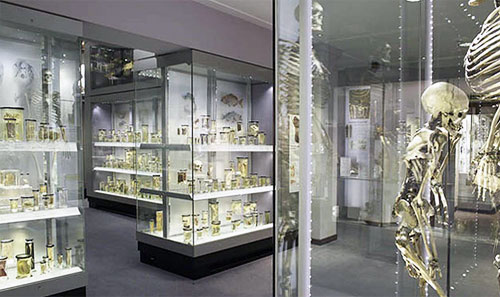
Sir John Soanes House and the Hunterian Museum have at least two things in common. They are at opposite ends of the same London Square, and both house a collection of historical objects that informed a life’s work.

The Hunterian holds a large range of zoological specimens that have been prodded, examined and compared for reasons of medical exploration. Visitors to the museum may reflect on the scientific relevance of these objects and squirm at their macabre beauty and variety of forms. The volume of glass and light in the museum gives the ensemble the appearance of a grotesque genetic fusion of animal and crystal candelabra. Like modernist steam-punk. Refractions of pale anaemic body parts glitter around the space in mesmerasing arrrays.

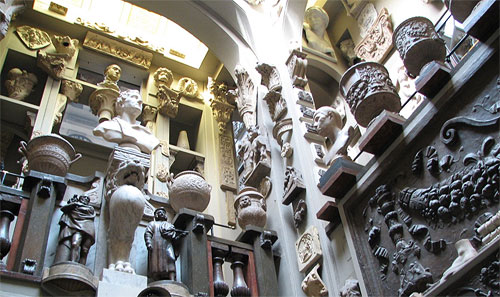
In comparison, Soane’s personal collection on the north of Lincoln’s Inn Fields represents one man’s obsession with the picturesque. The objects presented are of antiquity but not always authentic. Plaster models of original classical details picked up on tour informed Soanes classical revivalist approach to the architecture that he produced. As in the Hunterian, reflections from the many mirrors purposefully placed around the house create artificial layers of reconstructed views of the objects within.